
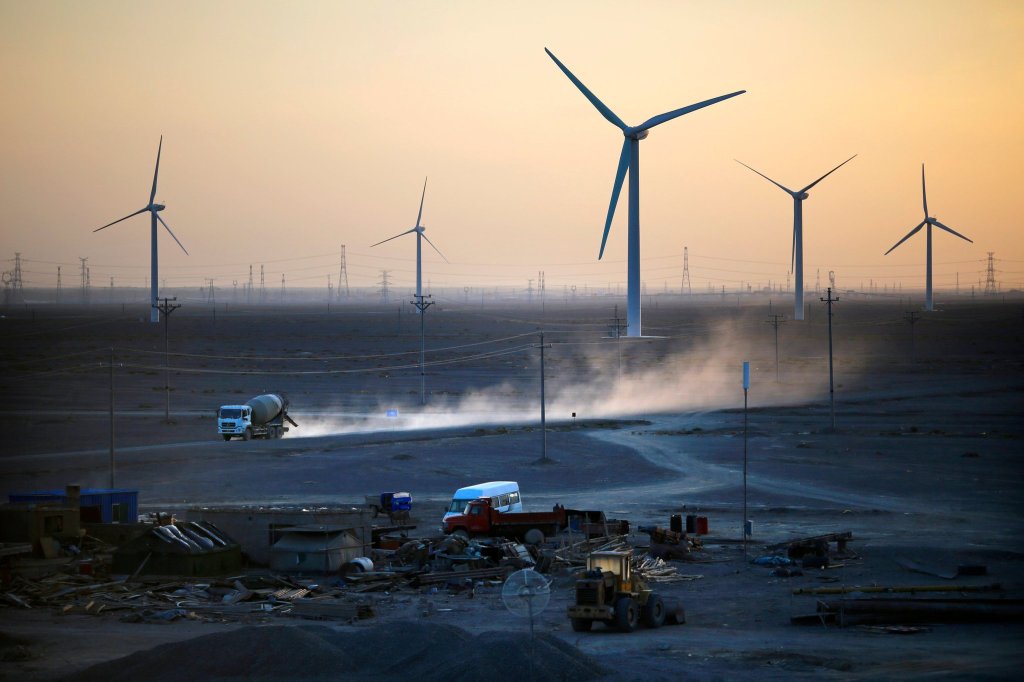
The energy transition has shifted a chunk of geopolitical leverage from traditional hydrocarbon exporters toward countries that dominate clean-tech manufacturing and mineral refining, above all China. But the shift is uneven: several upstream miners (Australia, Indonesia, Chile, DRC) also gained bargaining power, while the U.S./EU/Japan are racing to “de-risk” by onshoring and diversifying.
Here are some data points.
- Solar supply chain: China’s share of every major PV manufacturing stage (polysilicon, ingots/wafers, cells, modules) now exceeds 80%, after >US$50B of investment since 2011—giving Beijing price-setting and export leverage across a keystone technology of the transition. IEA
- Wind turbines: Chinese OEMs (Goldwind, Envision, MingYang, Windey) topped global turbine rankings in 2024, and China accounted for ~60% of global turbine production capacity; Europe and the U.S. trailed at ~19% and ~9% respectively. This consolidation has already triggered EU subsidy probes—an indicator of strategic dependence concerns. Wood Mackenzie+1
- Batteries & components: China regained #1 in BloombergNEF’s 2024 lithium-ion supply-chain ranking and controls a dominant share of cell manufacturing and key components (cathodes/anodes), reflecting deep midstream strength. The U.S. EIA estimates China made ~85% of battery cells by value and 74% of battery packs/components exports in 2023. BloombergNEF+1
- Critical-minerals refining choke points: IEA’s 2025 outlook finds refining is more concentrated than mining; for most transition minerals, China’s share rose to ~86% in 2024, with China the leading refiner for 19 of 20 minerals (avg. ~70% share). That midstream dominance is where geopolitical leverage bites. IEA+1
- Rare earths & magnets: China provides ~70% of rare-earth mine output and ~85–90% of processing. It has tightened regulatory control over the sector and previously restricted magnet-making know-how—leveraging a classic choke point (NdFeB magnets are used in wind turbines/EVs). In 2024 the U.S. still sourced ~70% of rare-earth compounds/metals from China. U.S. Geological Survey+1
- Graphite (EV anodes): China refines >90% of battery-grade graphite and in 2023 imposed export licensing on certain graphite products—an explicit use of supply-chain leverage. IEA highlights persistent concentration risks here. fticonsulting.com+1
- Gallium/germanium controls: Beijing’s 2023–24 export restrictions on gallium and germanium—metals crucial for chips, sensors and some clean-tech electronics—demonstrated coercive capacity rooted in ~98% and ~68% shares of global output respectively. CSIS+1
- According to a study by the United States Studies Centre at the University of Sydney, Australia imports about 96% of its solar modules from China. ussc.
- Counter-balancing shifts upstream: Resource holders have not been sidelined—some gained power by forcing domestic value-add. Indonesia’s nickel ore export ban (from 2020) pulled in large Chinese investment and made Indonesia the center of new HPAL/refining capacity, reshaping EV supply chains. Australia remained the largest lithium miner (2024), though much is refined in China—illustrating miners’ leverage tempered by midstream dependence. Investing News Network (INN)+3IEA+3IEA+3
Summary: Traditional petrostates still matter for oil & gas during the transition, but strategic leverage is clearly migrating to midstream refining and manufacturing nodes—and today those nodes are overwhelmingly in China. That’s why the U.S., EU, Japan and Australia are pouring money into non-Chinese refining (e.g., rare-earths via Lynas in Malaysia) and local clean-tech factories, and why Beijing’s targeted export controls immediately move markets. Reuters+2wsj.com+2

 Northstream Analytic