Why Most BESS Revenue Models Fail Under High FCAS Volatility

Battery Energy Storage Systems (BESS) are becoming central to NEM stability, arbitrage, and renewables integration. Yet despite rapid deployment, financial outcomes continue to diverge sharply from pre-investment revenue modelling. The common culprit: traditional modelling frameworks break down under high FCAS volatility.

2023–25 has delivered some of the most volatile FCAS conditions since the introduction of the contingency and regulation markets. Price spikes have become less predictable, event durations have become shorter and more clustered, and inter-regional price separation has intensified. Most BESS pro formas—built on smoothing assumptions or simplified dispatch logic—simply cannot capture real-world volatility.

The result? Systematically biased revenue forecasts, mis-optimised bidding behaviour, and an underestimation of portfolio risk.

This article sets out five reasons most BESS revenue models fail under high FCAS volatility, and how advanced modelling—like Northstream Analytic’s PowerStream short-term dispatch engine—overcomes these structural weaknesses.


1. FCAS Volatility Is Not Normally Distributed — But Most Models Pretend It Is

Many investment decks and banker-friendly models still assume:

  • Mean-reverting FCAS prices
  • Log-normal or normal distributions
  • Smooth temporal volatility without clustering

But the NEM’s FCAS markets consistently exhibit:

  • Heavy-tailed price distributions
  • Clustering of extreme events
  • Sudden regime shifts
  • State-dependent volatility (e.g., islanding risk, unit outages, wind ramps)

This means that using a single “average” FCAS price per service category is mathematically invalid. The tails drive the earnings: a handful of intervals can deliver >50% of annual FCAS revenue, especially for Raise/Lower Contingency services.

When models smooth this out, they under-forecast revenue in good years and over-forecast in bad years, giving investors a false sense of stability.


2. Static Capacity Allocation Assumptions Break During Price Spikes

A typical investor model sets fixed percentages of battery capacity to:

  • Energy arbitrage
  • FCAS regulation
  • FCAS contingency

But in real operations:

  • Energy and FCAS revenue stacks interact dynamically
  • The optimal allocation changes every 5 minutes
  • FCAS price spikes alter opportunity cost instantly
  • State of Charge (SOC) constraints limit which markets are viable

Static partitioning therefore suppresses upside in volatile FCAS conditions.

For example, during a high Raise 6-second event, the optimal strategy may shift from energy discharge to contingency enablement—but this shift is state-dependent and price-dependent, not rule-based.

Models that do not simulate real bidding strategy + SOC dynamics will systematically miss this.


3. SOC Constraints Under Volatility Create Nonlinear Profit Paths

Most simplified revenue models treat SOC as a linear constraint:

“Battery charges at low price, discharges at high price.”

Under FCAS volatility, SOC is instead a multi-dimensional optimisation problem involving:

  • Enablement depth
  • High-price tail events
  • Energy lost to regulation
  • Cycling limits and throughput penalties
  • Interaction with real-time AGC dispatch

This creates nonlinearities such as:

  • Being full too early → missing a late-day FCAS spike
  • Being empty during islanding risk → missing Raise contingency
  • Misaligned SOC trajectory → forced charging during expensive intervals

These complexities lead to revenue paths that no spreadsheet “averaging logic” can reasonably reproduce.

Only a constraint-based dispatch model can capture these dynamics.


4. FCAS Enablement and Compliance Are Not Perfectly Efficient

Real-world BESS operation loses revenue because:

  • Enablement often < 100% due to AGC behaviour
  • Causer-pays factors penalise poor performance
  • Compliance events reduce available MW
  • AGC movement consumes energy and reduces SOC stability
  • Thermal and inverter constraints limit maximum contingency enablement

Most revenue models assume perfect availability across all FCAS services.

This is rarely true. In fact, measured availability for some NEM assets can be as low as 70–80% after accounting for compliance and physical derating.

Ignoring this leads to:

  • Overestimated FCAS revenue
  • Underestimated degradation cycles
  • Incorrect valuation of control system quality

These errors compound under volatility.


5. Volatility Interacts With Degradation — A Hidden Cost

High FCAS volatility encourages batteries to chase short, high-value events.

But this often increases:

  • Cycling depth
  • Micro-cycling from AGC
  • C-rate stress
  • Temperature-related degradation

Degradation is nonlinear, not proportional to MWh throughput. One week of extreme FCAS activity can generate disproportionately large degradation events.

Simplified models typically assume:

  • A constant $/MWh degradation cost
  • Even cycling over time
  • No interaction between volatility and cell temperature

This is incorrect.

As FCAS volatility grows, ignoring nonlinear degradation overstates revenue and understates O&M reserves.


What a Valid BESS Revenue Model Must Include in a High-Volatility FCAS World

A robust model must integrate:

1. Five-minute NEMDE-aligned price simulation

Including scenario-based volatility and tail-event structure.

2. Full SOC trajectory modelling

Respecting charge/discharge rates, ramping, and energy constraints.

3. Co-optimised energy + FCAS bidding

Not preset allocations.

4. Compliance, enablement and AGC realism

Using empirical derating factors or control-loop simulation.

5. Nonlinear degradation modelling

Based on depth-of-cycle and stress factors.

6. Locational constraints and network constraints

Including MLF variability, curtailment risk, and islanding probabilities.


Conclusion: FCAS Volatility Rewards the Prepared and Punishes the Simplistic

As the NEM becomes more dynamic and renewable penetration increases, FCAS volatility is structurally rising—not falling. Batteries positioned to respond intelligently to this volatility will outperform their peers. But that requires models that reflect market reality, not spreadsheet mythology.

Most BESS investment models fail because they smooth what should be spiky, simplify what is nonlinear, and ignore what is stochastic.

If developers, investors, and operators want accurate forecasts, they need modelling frameworks built for volatility, not stability.

Northstream Analytic’s PowerStream modelling stack is built for this new world.

If you’d like us to run a project-specific BESS revenue assessment, reach out.

COP 30 coal pledges flow through to projected LNG demand: NS-WEM model LNG updates

Global energy markets are shifting again. At COP29 in Baku, governments launched a coordinated push for No New Coal, and the early outcomes of COP30 in Belém have continued the theme. The world is talking a big game —toward a phase-out of unabated coal power. For LNG markets, particularly through the 2030s, this has major implications if borne out in the power generation mix.

At Northstream Analytic, we have updated our NS-WEM world energy model to incorporate these scenarios. The results suggest a tightening in global LNG markets as coal-dependent countries turn to gas as well as renewables and nuclear.

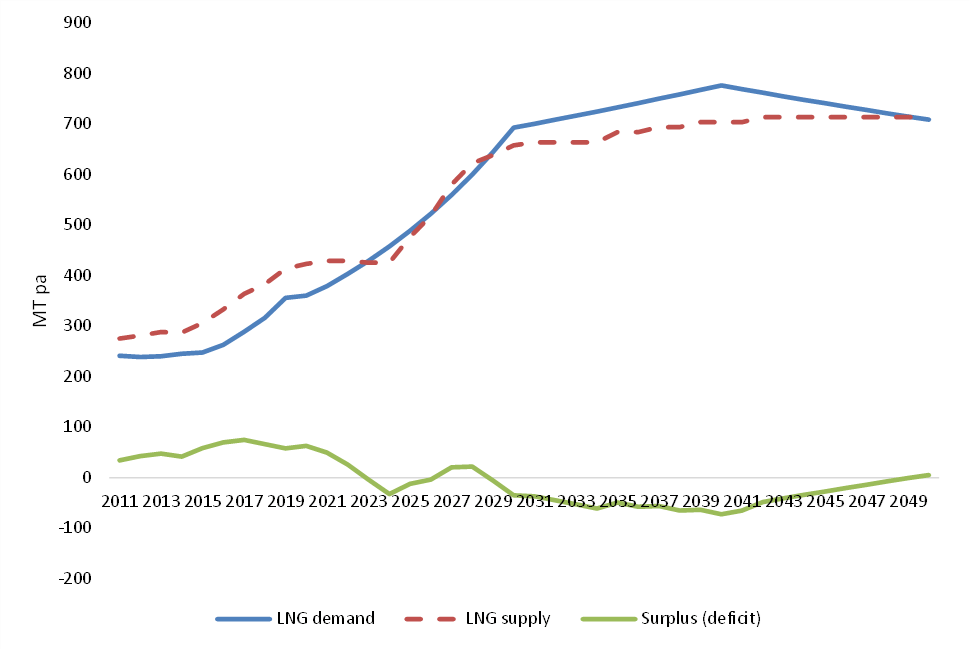
Figure 1: updated NS-WEM LNG projected demand-supply balance to 2050 (COP 30 Powering Past Coal scenario)


1. Roadmap to Phase Out Fossil Fuels?

The political momentum against coal has accelerated significantly since 2024, at least in the war of words.

COP29 – The No New Coal Pledge

At COP29, 25 countries and the EU launched the Call to Action for No New Coal, a diplomatic initiative to end the construction of new unabated coal power plants and to reflect this commitment in upcoming Nationally Determined Contributions (NDCs). While not a binding global moratorium, the pledge marked a clear shift: coal expansion is now politically unpalatable for most advanced economies.

COP30 – Toward a Planned Fossil Fuel Phase-Out

COP30 has gone a step further. More than 80 countries are backing text calling for a managed phase-out of fossil fuels, with coal identified for early retirement. Side announcements include updated coal exit timelines, expanded renewable and nuclear roadmaps, and early drafts of “just transition” coal retirement strategies. Coal is on a downward trajectory in global policy aspirations.


2. South Korea’s Move: Joining the Powering Past Coal Alliance

One of the most significant coal announcements at COP30 comes from South Korea—a major industrial economy with one of the largest coal fleets in the OECD.

At COP30, South Korea announced that it would phase out thermal coal by 2040 and formally joined the Powering Past Coal Alliance (PPCA). This places the country in the group of advanced economies committed to ending new unabated coal development and charting an orderly coal exit.

The Implications

South Korea’s electricity mix is currently anchored by nuclear, gas, and coal. Coal still provides roughly 30% of its electricity, but the new commitment accelerates planned retirements. In practice, Korea will:

  • Retire and repurpose existing coal power stations (including possible CCS conversions).
  • Convert a portion of these plants to LNG-fired generation.
  • Expand nuclear capacity to provide stable, low-carbon baseload.
  • Maintain gas as a reliability and flexibility source through the 2030s.

Civil society groups are pushing for an earlier coal phase-out (2030) and a cap on gas consumption, but these are not yet reflected in official policy.


3. What This Means for LNG Demand

The coal phase-out commitments emerging from COP29 and COP30 have two competing effects on LNG markets.

a) Upward Pressure: Gas as the Bridge Fuel

For many countries—particularly in Asia—gas remains the only mature, dispatchable alternative to coal during the 2030s while renewables, grids and storage scale up. South Korea’s decisions reinforce this dynamic:

  • Retired coal capacity will partly shift to LNG.
  • 26 coal units are slated for repurposing to gas and possibly CCS.
  • Gas-fired generation remains central to system reliability.

This mirrors broader emerging market trends. As coal retires faster, LNG demand rises—at least temporarily. This is borne out continuing LNG deal flow, and as countries continue to move away from reliance on Russian gas.

Table 1: Recently signed LNG supply deals

Buyer / CounterpartySupplier / CounterpartyVolumeStart DateDurationPrice / Pricing Mechanism
Uniper (Germany)Tourmaline Oil (Canada) via US liquefaction~0.56 million t/yr2028~8 yrsNet-back pricing linked to the European TTF hub (gas sold to TTF minus shipping & handling) (Energy Intelligence)
Centrica (UK)Tourmaline Oil (Canada) via US liquefaction~0.35 million t/yr2028~10 yrsNet-back pricing linked to TTF minus shipping & handling (Energy Intelligence)
MVM (Hungary)Engie (French utility trader)~0.30 million t/yr2028~10 yrsDelivered ex-ship (d.e.s.) basis, predominantly from US volumes (Energy Intelligence)
MVM (Hungary)US supplier (unnamed)~0.30 million t/yr2028~5 yrsNot specified (Energy Intelligence)
Naturgy (Spain)Venture Global (US exporter)~1.00 million t/yr2030~20 yrsFOB (free-on-board) basis; destination-free delivery (Energy Intelligence)
Atlantic‑See LNG (Greece)Venture Global (US exporter)~0.50 million t/yr2030~20 yrsFOB basis; destination-free delivery (Energy Intelligence)

b) Downward Pressure: The Growing Anti-Gas Policy Frontier

However, LNG growth is capped by several structural factors:

  • The nuclear renaissance in key markets (including Korea).
  • Declining costs of solar, wind, and battery storage.
  • Rising scrutiny of methane emissions in gas supply chains.
  • Concerns about locking in long-lived gas assets that could be stranded by the 2040s.

Even in South Korea, climate organisations argue that gas should peak before 2030 and decline thereafter. Whether the government ultimately follows this advice will determine the shape of long-run LNG demand.


4. Northstream’s NS-WEM Results: LNG Tightens in the 2030s

Northstream Analytic’s NS-WEM model has been updated with scenarios for COP commitments, coal retirement strategies, and country-level power sector plans. Under the policy settings announced so far, the model indicates:

▶ LNG markets tighten materially through the 2030s.

  1. Coal may exit faster than previously expected across multiple regions.
  2. Gas fills much of the transitional gap before large-scale renewables, storage and nuclear are fully built out.
  3. Upstream LNG investment has been cautious due to long-term decarbonisation uncertainty, but eventually catches up to rising demand.

The result is a decade of structurally firm LNG demand from the late 2020s into the 2030s.

However, the NS-WEM also shows that beyond the mid-2030s, LNG demand plateaus and risks a decline if accelerated gas phase-down policies take hold—especially in Europe and advanced Asia.


5. Strategic Takeaways

For policymakers

  • Coal phase-out initiatives must be paired with clear long-term gas transition strategies to avoid locking in emissions and stranded assets.

For LNG market participants

  • The 2030s are shaping up as a period of tight LNG balances, supporting pricing strength and contract demand.
  • But asset lifetimes beyond 2040 require careful risk assessment.